

Readers of this blog probably know I have a very low opinion of generative AI -- a low opinion that seems to be shared by many many other folks. At least it's good to not be alone, even if every interaction we have with tech companies is meant to think this whole thing is inevitable.
I do not believe generative AI is inevitable because no technological change is inevitable: all technologies are bound up in social processes, and social processes are by their nature contestable, debatable, and shapeable. (Keep protesting those data centers, y'all.)
But: there's a lot of AI-generated stuff out there. As I predicted last year, academic journal editors are reporting a massive uptick in AI-generated submissions, confirming what I've heard from other academic journal editors. Software code is being generated at an increased pace, as well. And since both academic journals and software developers rely on review, these developments are swamping peer reviewers.
But most folks out there probably aren't thinking about the plight of the academic peer reviewer or code reviewer. Instead, their experience of generative AI might be through social media, seeing AI-generated text, images, video, or music.
Much as in the case of being a reviewer of academic texts or software, such AI-generated content could be subject to review and criticism. I've been thinking about the possibilities of a critical engagement with AI-generated content. This is due to a new project I am now starting, one that I am not quite ready to publicly debut (but will soon!).
Which brings me to a bit of an interesting place, at least for me: a turn to aesthetics and art criticism.
Against Interpretation
And one text that has caught my eye for this new project is Susan Sontag's 1966 essay "Against Interpretation".
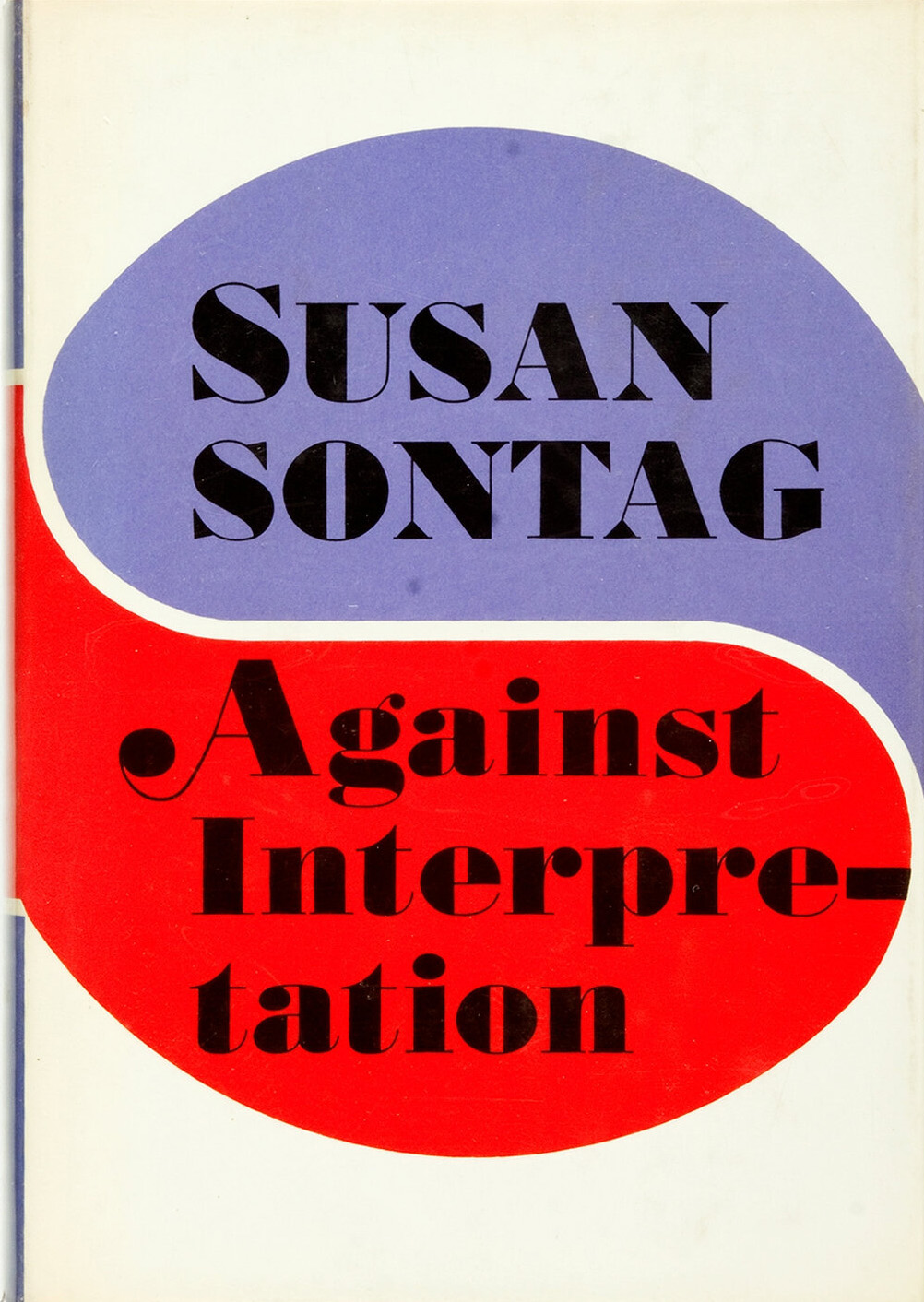
In that essay, Sontag argues that the dominant mode of art criticism is "interpretation." Interpretation is the examination of the content of the art in order to uncover its hidden meanings.
Interpretation has liberatory or stultifying potentials:
In some cultural contexts, interpretation is a liberating act. It is a means of revising, of transvaluing, of escaping the dead past. In other cultural contexts, it is reactionary, impertinent, cowardly, stifling.
She argues that the mode of interpretative criticism happening in the mid-twentieth century is the latter kind:
The old style of interpretation was insistent, but respectful; it erected another meaning on top of the literal one. The modern style of interpretation excavates, and as it excavates, destroys; it digs “behind” the text, to find a sub-text which is the true one.... Like the fumes of the automobile and of heavy industry which befoul the urban atmosphere, the effusion of interpretations of art today poisons our sensibilities.
Instead of experiencing art as art -- an approach she speculatively calls the "erotics of art," Sontag argues that art critics simply replace art with their own critical texts. She is particularly harsh in regards to literary critics -- for example, the "armies" of critics who "ravish" the works of Kafka or Beckett and build "thick encrustations of interpretation" around their work. She is also quick to note that such interpretative encrustations are built around more popular texts -- she cites the case of critical analysis of the film A Streetcar Named Desire as an example.
The core of her argument is that such interpretive encrustation is a reflection of the reduction of art to its content:
In most modern instances, interpretation amounts to the philistine refusal to leave the work of art alone. Real art has the capacity to make us nervous. By reducing the work of art to its content and then interpreting that, one tames the work of art. Interpretation makes art manageable, conformable.
For her, reducing art to its content ignores its form and how we experience that form. It is important to note that Sontag is not against criticism as such. Instead, she argues for critical analysis of form as well as critical attention to experience.
What is needed, first, is more attention to form in art. If excessive stress on content provokes the arrogance of interpretation, more extended and more thorough descriptions of form would silence. What is needed is a vocabulary—a descriptive, rather than prescriptive, vocabulary—for forms.... Our task is not to find the maximum amount of content in a work of art, much less to squeeze more content out of the work than is already there. Our task is to cut back content so that we can see the thing at all.
She suggests that film might be a good vehicle for this: instead of merely interpreting the meaning of the film's content, we could consider other aspects:
For the cinema... possesses a vocabulary of forms—the explicit, complex, and discussable technology of camera movements, cutting, and composition of the frame that goes into the making of a film.
Indeed, good film criticism does this sort of work. We could expand it and think about the acting, the characterization, the color palettes, the musical score, and many other formal elements besides.
Against Interpreting Prompts
So, Sontag's "Against Interpretation" is against two things: the reduction of art to its content, and the critical translation of that content into a new text.
It's a bit of a stretch to say this, but it's my blog, so here goes: she's arguing against creating content about content.
And that brings me to aesthetic criticism in the age of AI-generated content. If Sontag was concerned about content-upon-content, then AI-generated texts would have really bothered her. That's because there are three layers of content:
- The original creative works that the generative AI models were trained upon,
- the prompts that someone entered to generate content, and
- the AI-generated content itself.
So already there is a proliferation of encrusted content:
- The original works that the model was trained on are being contentified -- they are not being experienced as art, and the LLMs are not attending to any of their formal qualities. The LLMs are purely engaging with that art as digital data.
- The prompt is definitely not art. It's more content -- an interpretation of whatever the promptor is trying to produce.
- The result is AI-generated content. (As so many artists are now arguing, it is decidely not art.)
If we are to engage in criticism of AI-generated media, we would necessarily be engaging with content in the sense Sontag is describing: we would be working with the textual or symbolic aspects of the item at hand. To quote Sontag, generative AI's "excessive stress on content provokes the arrogance of interpretation."
That leaves little room for the other critical engagements Sontag calls for. Formal analysis is out of the question. Whereas film offers a massive vocabulary for analysis (camera angles, editing, acting choices, musical score, etc), AI-generated content does not. The machine makes the choices about much of the art. In the case of a AI-generated video, the machine produces a shot that is framed and a series of shots that are edited, perhaps, but we cannot speak of that AI making choices in doing so. (To do that would be to falsely attribute the capacity to make decisions to machines that simply produce likely outcomes based on their training.)
What of the experience of AI-generated content as art? Maybe we could speak of this: what does it feel like to encounter AI-generated "art"? I think we will see much reflection on this in the years to come, but I also think this leads to critical bankruptcy.
A Short Case Study: The Velvet Sundown
Last summer, The Velvet Sundown, a band that was going viral on Spotify, was revealed to be entirely AI-generated.
I have a particular interest in making music -- I was, once upon a time, a professional musician, playing bass in a variety of bands. I even did a very short stint on Nashville's Broadway, doing shifts playing country bass. I don't play professionally anymore, but I certainly hack on multiple instruments -- I've done that for more than two decades. I also do home audio recording as a hobby.
So you can imagine how nauseated I might be by the idea of an AI-generated band. But I want to set aside that nausea to think about this as something that can be critiqued for its aesthetics, particularly in light of what Sontag writes.
Take the example of The Velvet Sundown's "Dust on The Wind".
Can we take that song and engage with it critically?
If we take it as content, then the answer is: yes. That's Sontag's whole point. I could write an essay that reveals the hidden meanings within the track, interpreting lyrics such as "march for peace / not for pride" or "smoke will clear / truth won't bend." I could take a look at the band's generated portrait and reflect on how their attire reflects a nostalgia for 1970s Americana.
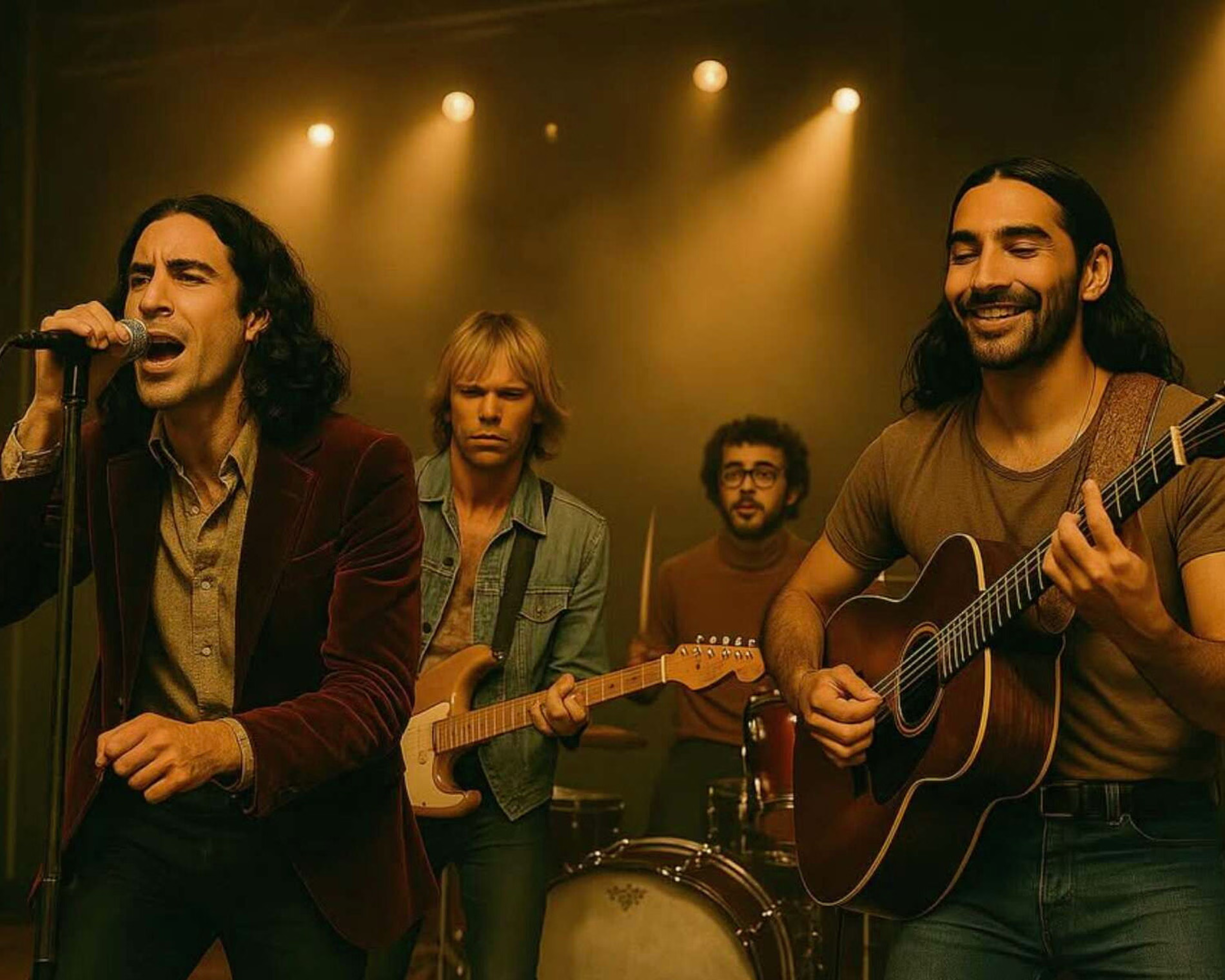
I might even listen to the music and ponder some of its elements: the wooly bass tone, the muted drums and acoustic guitar, etc.
But enough already. That's basically all I can do -- encrust its content with some interpretation. And given that this band's music and image were no doubt created from a prompt that itself was something like "write a song in the style of X, Y, or Z band", my interpretation would really be the interpretation of a promptor's interpretation along with an interpretation of a machine's interpretation of that prompt and its training data.
Talk about encrustation.
What of the other approaches, the ones Sontag argues for instead of interpretation?
If I want to consider the Velvet Sundown from a formal angle, I am going to run out of options fast. I cannot speak of things like guitar, bass, or drum technique. There is none. There never was a guitar player or drummer. I can't speak of vocal technique -- there never was a singer controlling his vocalizations, making choices about how to approach each note. I can't speak of the audio engineering techniques: there never were any microphones in the room. There wasn't a room in which anyone played, for that matter!
At most the only formal aspects I could engage with are a) the prompt and b) the model. I don't have the prompt, but if the promptor were to share it, we could read it. We could also consider the model.
That's pretty thin on the formal front.
In contrast, if you want examples of a formal criticism of a very similar song, a useful video comes from a Nashville-based band, the Sons of Legion, who covered "Dust on the Wind" and created a video exploring how they did it. While they don't go into a lot of detail, they do discuss drum micing as a special art form -- that immediately gives us a window into the formal aspects of music making. And there's a lot more, of course: you can hear the guitar player's interaction with the strings, the drummer's choices of accents, and the singer's vocalizations.
So what about the experience of engaging with The Velvet Sundown's "Dust on the Wind"? I mean... it's boring as fucking hell. The Sons of Legion's version is far superior.
So if we are to have to live in a world full of AI-generated "art," we would have these responses:
- Make more content that explains the content,
- Maybe write something about formal aspects: the prompt or the model and nothing more, and
- Write about the experience of engaging with the content.
Thinking with Sontag, then, we are very limited. The most accessible thing is to make more content about content and further "befoul" our world.
At best, we might reflect on our experiences of this content. The question is: what good would that do? Is that a world we want to live in?
Keep protesting those data centers.
Comments
For each of these posts, I will also post to Mastodon. If you have a fediverse account and reply to my Mastodon post, that shows up as a comment on this blog unless you change your privacy settings to followers-only or DM. Content warnings will work. You can delete your comment by deleting it through Mastodon.
Don't have a fediverse account and you want one? Ask me how! robertwgehl AT protonmail . com
Reply through Fediverse